Lift, power, control
How Wanderer flies, explained without jargon where we can, and with the jargon defined where we cannot.
Lift
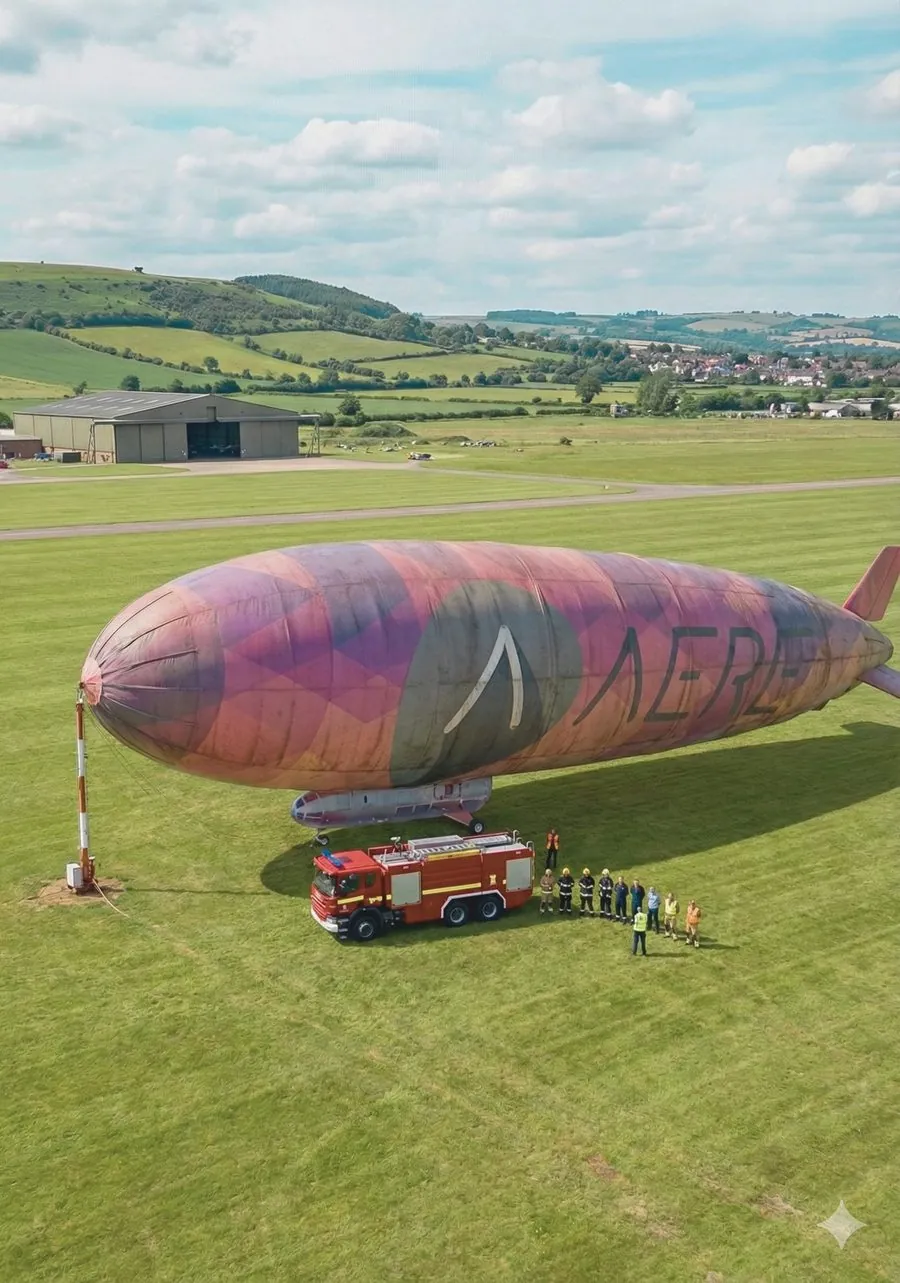
A non-rigid helium envelope carries the ship. Inside it, two air bags called ballonets are inflated or vented to keep the hull taut as altitude and temperature change. The ship is designed to be slightly heavier than the air it displaces, by about 1.6 percent of its weight, so it settles gently when the motors stop instead of drifting up.
- Ballonet
- an air bag inside the envelope; filling or venting it keeps the hull pressure steady
- Static heaviness
- how much heavier the ship is than the air it displaces; a small positive value is normal for a passenger airship
Power
A 38 kW piston generator burns a small amount of fuel and feeds a shared electrical connection, the DC bus, at about 350 volts. Three electric motors take their power from the bus. A 10 kWh battery sits on the same bus: it smooths short bursts of demand and gives a reserve for approach and landing if the generator stops.
- DC bus
- the shared electrical connection between generator, battery and motors
- Series hybrid
- the engine never turns the propellers directly; it only makes electricity
Control
Conventional control surfaces on an X-shaped tail, moved by the pilot through mechanical linkages in the baseline design. Keeping the controls unpowered keeps the ship inside the light-airship class of the certification rules.
Certification: what is a design basis, what is planned, what is approved
- Design basis (published documents we design to)
- EASA SC-GAS Issue 01 for gas airships; SC E-19 for electric and hybrid propulsion; the SC-VTOL means of compliance for the buffer battery
- Process (planned path)
- Türkiye’s SHT-21, aligned with EASA Part 21. Pre-application with SHGM in preparation.
- Approvals obtained
- None yet. No type certificate, permit to fly or operating licence has been applied for or granted.
Development history
- 2011Kuzgun
Kuzgun, a modular unmanned airship concept, is patented in Türkiye (TR 2011 03453 B). Two prototypes fly.
- 2012Sub-scale programme
Our chief engineer begins building sub-scale airships. More than 80 built and 20 flown since; one test article was kept aloft for more than 365 days in a hangar endurance test in Eskişehir.
- 2019AERE
AERE Airships is founded in Istanbul in February. The first Wanderer concept drawings reach revision 3 in December.
- 2026Hybrid-electric v1
Propulsion decision: series hybrid-electric. The Wanderer v1 concept design is completed in September, with the certification path mapped.
The full-size envelope test and the 365-day endurance test are shown on the home page; their dates will be added to this timeline.
Kuzgun heritage
Kuzgun is a modular unmanned aerial vehicle concept patented in Türkiye in 2011 (TR 2011 03453 B). Two prototypes have flown. The same hull family scales from sub-scale test articles to Wanderer.